

Have you ever wondered if your business is truly prepared for the next wave of digital transformation? Across the United States, artificial intelligence is rapidly evolving from a luxury experiment into the essential backbone of modern corporate strategy.
Tech hubs from Silicon Valley to Austin are witnessing a massive shift in how companies handle complex operations. This transition is not just about staying current; it is about securing a competitive advantage in an increasingly automated economy.
As data science becomes more accessible, organizations are finding new ways to drive efficiency and innovation. These sophisticated algorithms are no longer futuristic concepts but are present-day necessities for any firm aiming to thrive. Understanding these shifts is the first step toward mastering the digital infrastructure of tomorrow.
Key Takeaways
- Artificial intelligence is now a core requirement for American business success.
- Data science serves as the foundation for modern corporate decision-making.
- Technological evolution is reshaping digital infrastructure across major U.S. hubs.
- Sophisticated algorithms are significantly boosting operational efficiency.
- Adopting these tools is essential for maintaining a competitive edge today.
The Current Landscape of Machine Learning in the U.S.
Machine learning has evolved from a niche research interest into the backbone of modern United States enterprise operations. Organizations across the country are rapidly adopting sophisticated models to gain a competitive edge in an increasingly digital economy. This shift represents a fundamental change in how businesses approach problem-solving and strategic planning.
Advancements in Generative AI and Neural Networks
The maturation of neural networks has paved the way for highly capable generative AI tools. These systems utilize deep learning architectures to process massive, complex datasets with unprecedented speed. By identifying subtle patterns that human analysts might miss, these models provide actionable insights that drive innovation.
Furthermore, the integration of natural language processing into standard data science workflows has transformed human-computer interaction. Employees can now query databases using conversational language, making advanced analytics accessible to non-technical staff. This democratization of information is a hallmark of the current technological era in the U.S.
The Shift Toward Edge Computing and Real-Time Data Processing
A critical transition is currently underway as companies move away from centralized cloud reliance toward edge computing. By processing information closer to the source, businesses achieve significantly lower latency. This capability is essential for applications requiring real-time decision-making, such as autonomous systems and smart manufacturing.
The following table highlights the key differences between traditional centralized models and modern edge-based architectures:
| Feature | Centralized Cloud | Edge Computing |
|---|---|---|
| Latency | High | Ultra-Low |
| Data Security | Centralized Risk | Distributed Protection |
| Bandwidth Usage | High Consumption | Optimized Efficiency |
| Primary Use Case | Batch Processing | Real-Time Analytics |
As these technologies continue to converge, the reliance on robust machine learning frameworks will only grow. American enterprises that prioritize these advancements are better positioned to navigate the complexities of the modern market. The future of data science remains deeply tied to these ongoing infrastructure improvements.
Industry-Specific Impacts of Artificial Intelligence
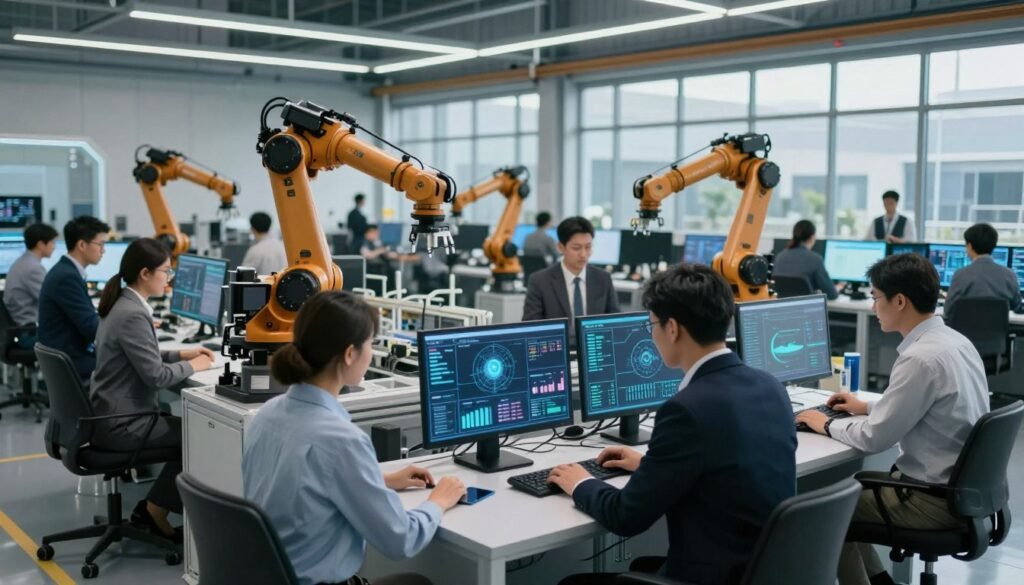
Artificial intelligence is no longer a futuristic concept but a practical engine for industrial growth. Across the United States, organizations are moving beyond basic automation to implement systems that learn and adapt in real-time. This shift allows businesses to maximize operational efficiency while reducing human error in critical processes.
Healthcare Innovations and Predictive Diagnostics
The medical field is currently experiencing a revolution through the application of advanced neural networks. These systems analyze vast datasets to identify patient risks long before physical symptoms manifest. By detecting subtle health markers, providers can offer proactive interventions that significantly improve long-term patient outcomes.
Clinicians now rely on these tools to synthesize complex diagnostic imaging and genetic data. This capability ensures that treatment plans are highly personalized and accurate. As a result, hospitals are seeing a marked decrease in diagnostic delays and improved resource allocation.
Financial Sector Security and Fraud Detection
In the financial world, the primary goal is maintaining trust through robust security measures. Financial institutions utilize supervised learning models to monitor millions of transactions every second. These models are trained on historical data to recognize even the most sophisticated patterns of illicit activity.
When a transaction deviates from a user’s typical behavior, the system flags it for immediate review. This high-precision detection protects both the institution and the consumer from financial loss. By automating these security protocols, banks can focus on providing better services to their clients.
Supply Chain Optimization and Autonomous Logistics
Modern supply chains are incredibly complex, often spanning multiple continents and time zones. Companies are now turning to unsupervised learning to uncover hidden patterns within their logistics networks. This approach helps managers identify bottlenecks and streamline operations without manual oversight.
Autonomous logistics systems use these insights to optimize routing and inventory management in real-time. This leads to significant cost savings and faster delivery times for consumers. By leveraging machine learning, companies can maintain a competitive edge in an increasingly demanding global market.
Conclusion
The rapid evolution of artificial intelligence continues to reshape the economic landscape across the United States. Businesses that leverage the power of data science gain a distinct advantage in a crowded marketplace. This transformation relies on the seamless integration of advanced computational models into daily operations.
Success in this digital era requires a deep understanding of both supervised learning and unsupervised learning techniques. Companies must balance these approaches to extract meaningful insights from complex datasets. Mastering these methods allows organizations to predict market shifts with greater accuracy.
The synergy between deep learning and modern infrastructure creates endless possibilities for growth. Leaders who prioritize these technologies position themselves at the forefront of global innovation. This commitment to technical excellence drives progress in every major sector.
Natural language processing remains a vital component of this technological journey. It bridges the gap between human intent and machine execution. Explore these emerging tools today to ensure your organization stays ahead of the curve in the coming years.
FAQ
How is machine learning currently reshaping the digital infrastructure in the United States?
Across major American tech hubs from Silicon Valley to Austin, machine learning has evolved into a fundamental component of corporate strategy. By leveraging advanced data science, businesses are moving beyond experimental phases to implement sophisticated algorithms that drive unprecedented operational efficiency and competitive advantages in the domestic market.
What role do neural networks and deep learning play in the advancement of generative AI?
The maturation of neural networks is central to the latest generative AI tools used by enterprises like Microsoft and NVIDIA. Current deep learning architectures are being optimized to process complex datasets with far greater speed and accuracy, allowing for more robust and creative outputs that support various professional workflows.
Why is the shift toward edge computing vital for real-time data processing?
Edge computing allows for real-time data processing to occur closer to the actual source of information rather than in a centralized cloud. This reduction in latency is critical for modern artificial intelligence applications that require immediate responses, such as autonomous vehicles and high-frequency trading platforms.
How is natural language processing being integrated into standard data science workflows?
Natural language processing (NLP) is no longer a standalone field but is now a core part of human-computer interaction. By integrating NLP into standard data science pipelines, companies can better interpret unstructured data, leading to more intuitive interfaces and more accurate sentiment analysis for consumer-facing brands.
In what ways is supervised learning specifically benefiting the financial sector?
The financial industry utilizes supervised learning to bolster security and fraud detection. By training models on labeled historical data, institutions like JPMorgan Chase can identify fraudulent transactions with high precision, protecting both the institution and the consumer from evolving cyber threats.
How does unsupervised learning contribute to supply chain optimization and autonomous logistics?
Unlike traditional methods, unsupervised learning excels at identifying hidden patterns within massive, unlabeled datasets. In logistics and supply chain management, these machine learning models help companies discover inefficiencies and streamline autonomous operations, leading to more resilient and cost-effective distribution networks.
Why is artificial intelligence becoming a necessity for healthcare innovations and predictive diagnostics?
Artificial intelligence is revolutionizing healthcare by enabling predictive diagnostics that can identify potential patient risks before symptoms even manifest. By utilizing neural networks to analyze medical imaging and patient records, providers can deliver proactive care that significantly improves patient outcomes and operational milestones.
Why is it important for professionals to master both supervised learning and unsupervised learning?
To remain competitive in a rapidly changing economy, a comprehensive understanding of both supervised learning and unsupervised learning is essential. These techniques, combined with deep learning capabilities, empower innovators to solve diverse problems across every major industry, from personalized marketing to complex scientific research.











Leave a Reply