
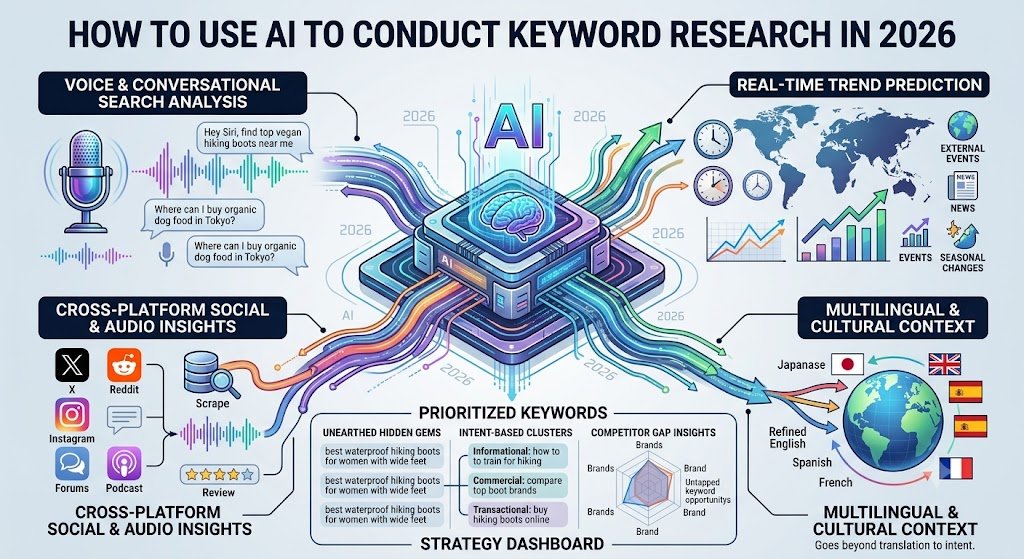
Best AI tools for keyword research in 2026 :
Hey there, fellow content creators and business builders! It’s anonymous here, and today we’re talking about something really exciting: how you’ll be using AI to do your keyword research in 2026. Yes, that’s just around the corner!
Keyword research has always been the backbone of getting your stuff found online. It’s how you figure out what words people type into search engines. Knowing these words helps you create content that gets seen. But the way we do it is changing fast.
AI, or Artificial Intelligence, is making things much smarter. It’s not just about simple tools anymore. By 2026, AI will be a core part of how we discover what our audience really wants. It will help us find those perfect words that bring people to our websites. We’re talking about a big step up from what we do today. Let’s get into it!
Why Keyword Research Still Matters (Even with Smart AI)
You might hear some people say keyword research is not as important as it used to be. I don’t agree. In my view, it’s more important than ever. It’s just evolving. In 2026, people will still use search engines to find answers, products, and information.
The core idea behind keyword research stays the same. You want to understand what your potential customers or readers are looking for. You want to speak their language. If you don’t use their words, they won’t find you. Simple as that.
Think about it like this: if you sell amazing handmade scarves, you need to know if people search for “warm winter scarves,” “stylish neckwear,” or “cozy knitted wraps.” Each phrase tells you something different about what they want. Keyword research helps you find these phrases.
Even with advanced search engines that “understand” queries better, using the right keywords is still your best bet for ranking high. It’s about matching your helpful content to their exact questions. This helps you connect with your audience. And that’s always a good thing, right?
AI’s Big Role in Our Work Now
AI is already everywhere. It helps us with emails, suggests what movies to watch, and even drives some cars. In online business and content, AI is becoming a huge helper too. It takes away the boring, repetitive tasks.
Think about how much time you spend on research. AI can cut that down dramatically. It can look at huge amounts of data in seconds. Things that would take a human days or weeks, AI can do in minutes.
This means we can focus on the creative stuff. We can spend more time writing great articles, making cool videos, or designing awesome products. AI handles the heavy lifting of data analysis. It’s like having a super-smart assistant who never sleeps.
In 2026, AI tools will be even more common and easier to use. They won’t just be for tech experts. Everyday blog writers and small business owners will be using them. This makes the playing field more even for everyone.
How AI Changes Keyword Research for the Better
So, what does this mean for keyword research specifically? It means we’re moving beyond guessing games and basic tools. AI brings a level of depth and speed we’ve never had before.
Traditional keyword research often involves looking at search volume and competition. You might use a few tools to find related words. Then you pick the ones that look good. This can be a bit hit-or-miss sometimes.
AI, however, can look at not just the words, but the whole context. It can understand the feeling behind a search. It can predict what people will search for next. It can even tell you what kind of content will best answer a specific question.
This shift means our keyword lists will be smarter. Our content will be more targeted. We’ll be able to reach the right people at the right time. It’s all about working smarter, not just harder, thanks to AI. Ready to see how?
AI for Finding Keywords You Never Knew Existed
One of the biggest benefits of AI in 2026 will be its power to uncover hidden gem keywords. These are words and phrases that traditional tools often miss. They might have lower search volume, but they bring in very targeted traffic. These visitors are often ready to buy or learn more.
AI tools will go beyond just showing you related terms. They will look at forums, social media discussions, customer reviews, and even voice search queries. They will find the natural language people use. This gives you a much bigger picture.
Imagine an AI tool that listens to podcasts in your niche. It then pulls out common questions and concerns that listeners have. These might be keywords no one has even thought to target yet. That’s the kind of smart help we’re talking about for 2026.
AI can also spot emerging trends much faster than a human. It can see a slight increase in interest for a topic before it becomes popular. This lets you create content early and become a leader in that new area. This is a huge advantage.
It can also analyze long-tail keywords better. These are longer, more specific phrases, like “best waterproof hiking boots for women with wide feet.” AI can help you find many of these specific queries. These often have less competition and bring in highly interested visitors.
So, instead of just seeing “hiking boots,” AI will show you all the detailed questions people ask. This helps you create super specific content that truly helps your audience. It helps you stand out.
AI for Really Understanding What People Want (User Intent)
Knowing the words people type is good. Knowing *why* they type those words is even better. This is called “user intent,” and AI will be amazing at figuring it out in 2026.
Is someone looking to buy something? Are they just trying to learn? Are they looking for a specific website? AI can tell the difference. This helps you create the right kind of content for each keyword.
For example, if someone searches for “best running shoes,” their intent is likely to compare and possibly buy. If they search for “how do running shoes work,” their intent is informational. They want to learn.
AI in 2026 will use advanced language processing to look at millions of search results. It will analyze what kind of content ranks for each keyword. Then, it will tell you if the intent is:
- Informational: People want to learn.
- Navigational: People want to go to a specific website.
- Transactional: People want to buy something.
- Commercial Investigation: People are researching before buying.
This means you won’t waste time creating a sales page for an informational keyword. Or writing a long guide for someone who just wants to click “buy.” AI helps you make sure your content perfectly matches what your audience wants to do.
AI for Seeing What Your Competitors Are Doing
Keeping an eye on your competitors is always smart. What keywords are they ranking for? What kind of content are they creating? AI will make this process much deeper and faster in 2026.
AI tools will be able to analyze your competitors’ entire online presence. They won’t just show you their top keywords. They will show you their keyword strategy. They can tell you which keywords your competitors are trying to rank for but are not doing well on. These might be opportunities for you.
They can also look at the gaps. Are your competitors missing certain topics or keywords that your audience cares about? AI can find these “content gaps” for you. Then, you can jump in and create content that fills those needs. This is a great way to get ahead.
Imagine an AI tool that gives you a full report on your top five competitors. It shows you their content plans for the next six months. It highlights their strengths and weaknesses. This gives you a clear path to beat them at their own game.
This kind of competitive analysis used to take a lot of manual work and guesswork. In 2026, AI will turn it into a quick, insightful process. It gives you a clear roadmap to success.
AI for Organizing Keywords Like a Pro (Clustering)
Once you have a big list of keywords, what do you do with them? It can be overwhelming. This is where keyword clustering, powered by AI, becomes incredibly useful.
Keyword clustering means grouping similar keywords together. For example, “best running shoes,” “top running sneakers,” and “running shoe reviews” are all about the same topic. You might be able to target all of them with one really good piece of content.
AI in 2026 will automatically group your keywords. It will use advanced logic to understand which keywords belong together. It won’t just look for similar words. It will look at shared user intent and search results. This creates very smart groupings.
This helps you plan your content strategy much better. Instead of creating a separate article for every single keyword, you can create one complete article for a whole group of related keywords. This saves you time and makes your content stronger. It also helps search engines understand your content better.
This helps you build a strong “topic cluster” strategy. You create one main article on a broad topic. Then you create several smaller articles that go deeper into related sub-topics. These all link back to your main article. AI helps you map this out efficiently.
AI for Guessing What’s Next (Trend Prediction)
Imagine knowing what will be popular next week, next month, or even next year. AI can help with this. In 2026, AI will be much better at predicting future trends in search.
It does this by looking at massive amounts of historical data. It sees patterns in how topics rise and fall in popularity. It can also analyze external factors, like news events or seasonal changes, to make educated guesses.
This means you can get a head start. You can create content about a trending topic before everyone else does. This helps you capture traffic while competition is low. It’s like having a crystal ball for your content plan.
For a business, this is huge. If you know a certain product or service will become popular, you can prepare your marketing. You can get your inventory ready. For bloggers, it means you can write about topics that are about to explode. This brings in a lot of new readers.
This trend prediction also helps you avoid wasting time on topics that are losing interest. AI can warn you if a keyword is becoming less popular. This helps you focus your efforts where they will make the most impact.
AI for Getting New Content Ideas
Keyword research isn’t just about finding words. It’s about finding ideas for your content. AI in 2026 will take this a step further. It will not only give you keywords but also suggest actual content ideas based on them.
Let’s say you find a keyword like “how to start a garden in a small space.” An AI tool might not just show you the search volume. It could suggest blog post titles, video topics, or even a mini-course outline. It can look at what kind of content already ranks for that keyword and suggest ways to make yours even better.
It can analyze user questions related to that keyword. It can break down what people are asking. Then it can tell you the best format to answer those questions. Should it be a listicle? A step-by-step guide? A video tutorial?
This greatly speeds up the content creation process. You go from a keyword to a full content brief in minutes. This frees up your time to actually write and create. For more tips on making your writing shine, you might want to check out our guide on writing great content.
AI can also help you find different angles for the same topic. If “healthy breakfast ideas” is a keyword, AI might suggest “healthy breakfast ideas for busy moms,” “healthy breakfast ideas on a budget,” or “healthy breakfast ideas for weight loss.” This helps you create diverse content.
AI for Local and Voice Searches
In 2026, local searches and voice searches will be even more common. AI is perfectly suited to help with both of these specific types of keyword research.
Local Search: People often look for businesses and services “near me.” For example, “coffee shop near me” or “best plumber in [city name].” AI can help you find geographically specific keywords. It can identify local jargon or specific neighborhoods people mention.
AI tools will be able to analyze local search behavior. They can help you understand how people in a specific area search for your products or services. This is super helpful for local businesses trying to attract nearby customers.
Voice Search: When people use voice assistants like Siri or Alexa, they speak differently. They use full sentences and ask questions. For example, instead of typing “weather Los Angeles,” they might ask, “Hey Siri, what’s the weather like in Los Angeles today?”
AI will be able to find these conversational keywords. It can analyze spoken language patterns. This helps you create content that answers these direct questions. If someone asks, “Where can I buy organic dog food near me?” your AI-optimized content will be ready to answer.
This means your content needs to be ready for both text and voice searches. AI helps you bridge that gap. It makes sure you’re found no matter how someone searches.
AI for Multilingual Keyword Research
If you have an international audience or want to reach people in different countries, multilingual keyword research is key. Doing this manually for many languages is a huge task. But AI in 2026 will make it much simpler.
AI language models are becoming very good at understanding different languages. They can find keywords in Spanish, French, German, and many other languages. They don’t just translate words. They understand the cultural context and how people in different regions search.
This means you can expand your reach globally without needing a team of language experts for keyword research. AI can help you identify relevant keywords and content opportunities in markets all over the world. This opens up many new possibilities for growth.
It can also help you understand nuances. A direct translation of a keyword might not be what people actually search for in another country. AI can spot these differences. It helps you create truly effective content for diverse audiences.
Choosing the Right AI Tools (Without Naming Brands)
By 2026, there will be many AI tools for keyword research. How do you pick the best ones? Here are a few things I think you should look for:
- Ease of Use: The tool should be simple to understand. You shouldn’t need to be a data scientist to use it.
- Accuracy: The insights it gives you must be reliable. Does it provide good data?
- Depth of Analysis: Does it go beyond basic keywords? Does it help with intent, clustering, and trends?
- Integration: Can it work with other tools you use, like your content planner or SEO software?
- Customization: Can you tell it what to focus on? Can you adjust its settings for your specific needs?
- Updates: Is the tool regularly improved? AI technology changes fast, so you want a tool that keeps up.
Don’t just pick the first tool you see. Do some research. Read reviews. Many tools offer free trials. Take advantage of those. See how the tool fits into your workflow. Does it actually save you time and give you better results? That’s what really matters.
Remember, the best tool is the one that helps you achieve your goals. It should make your life easier, not more complicated. So, take your time and choose wisely.
Why Your Brain Still Matters (The Human Touch)
This is a really important point. While AI will be incredibly powerful in 2026, it’s not going to replace human thinking. Think of AI as your super-smart assistant, not your boss.
AI can give you all the data, all the keywords, and all the trends. But you still need to interpret that information. You need to apply your knowledge of your audience and your business. You need to add your creativity.
For example, AI might show you a trending keyword. But you, the human, decide if that keyword fits your brand voice. You decide if it aligns with your values. You decide if you can create truly unique and helpful content around it.
Your empathy for your audience is something AI doesn’t have. Your ability to tell a strong story is unique. Your understanding of complex human emotions and desires is what makes content truly connect.
So, don’t worry about AI taking your job. Instead, learn how to work with it. Use it to make your work better, faster, and more impactful. Your human touch will always be the secret sauce.
Things to Watch Out For and Challenges
Even with all its amazing benefits, using AI for keyword research in 2026 will have some things to watch out for. No tool is perfect, right?
One challenge is data quality. AI is only as good as the data it learns from. If the data is biased or incomplete, the results might not be accurate. Always question the output a little. Use your common sense.
Another thing is over-reliance. It’s easy to just take AI suggestions and run with them. But you need to stay engaged. Don’t let the AI do all the thinking. Review its suggestions. Make sure they make sense for your specific situation.
The cost of AI tools can also be a factor. Some advanced AI solutions might be expensive. You need to weigh the cost against the benefits. Does it really provide enough value to justify the price?
Finally, the world of AI and search is always changing. What works today might be different tomorrow. You need to stay updated. Keep learning about new AI methods and changes in search engine algorithms. You can always check our blog homepage for the latest updates and tips.
Looking Ahead: The Bright Future
The future of keyword research with AI in 2026 looks bright. It promises a world where finding what your audience wants is easier and more precise than ever before. We’ll spend less time on tedious tasks and more time creating amazing things.
AI will keep getting smarter, faster, and more integrated into our daily work. It will change how we approach online marketing and content forever. This is an exciting time to be in the game!
So, get ready to embrace these new tools. Learn how to use them effectively. Combine AI’s power with your own smarts and creativity. You’ll be well on your way to success in 2026 and beyond. What do you think about these changes? Are you ready for them?










Leave a Reply